

Shandong Science ›› 2021, Vol. 34 ›› Issue (6): 41-50.doi: 10.3976/j.issn.1002-4026.2021.06.006
• Pharmacology and Toxicology • Previous Articles Next Articles
PAN Hui-jun1,2( ),ZHU Quan-gang1,2,ZHU Cong-cong1
Received:2021-01-06
Published:2021-12-20
Online:2021-12-13
CLC Number:
PAN Hui-jun,ZHU Quan-gang,ZHU Cong-cong. Network pharmacology study on the anti-inflammatory mechanism of Anemarrhenae Rhizoma-Rhellodendri Chinensis Cortex combination[J].Shandong Science, 2021, 34(6): 41-50.
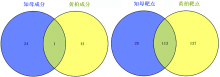
Fig.1
Venn diagram of the chemical constituents and targets of Anemarrhenae Rhizoma-Rhellodendri Chinensis Cortex"

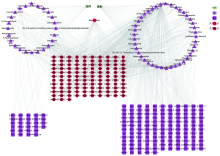
Fig.2
Network diagram of the chemical constituents and targets of Anemarrhenae Rhizoma-Rhellodendri Chinensis Cortex"

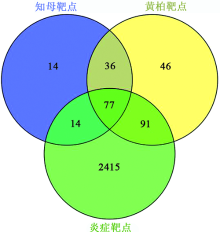
Fig.3
Venn diagram of the targets of Anemarrhenae Rhizoma-Rhellodendri Chinensis Cortex and inflammation"
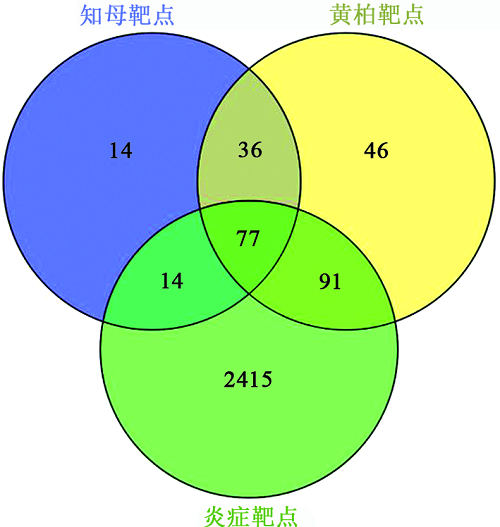
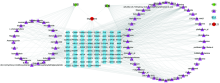
Fig.4
Network diagram of TCM-constituents-targets"
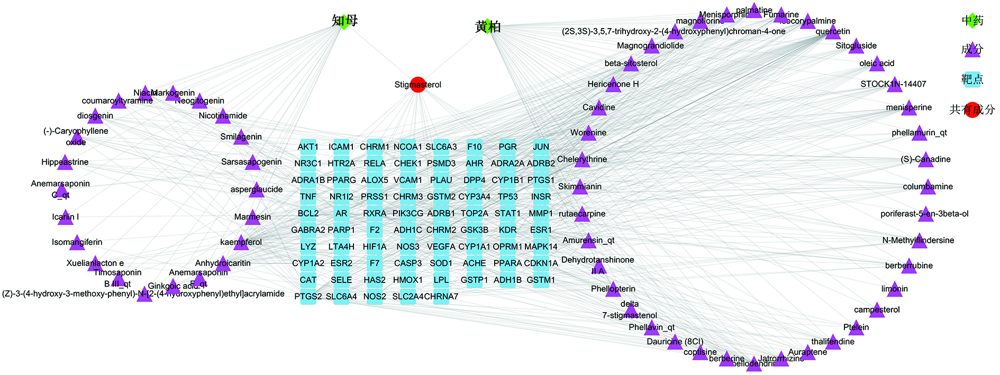
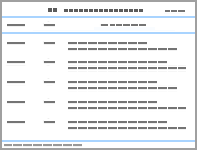
Table 1
Regulated scores of targets"
| 靶点 | 受知母调 控得分 | 受黄柏调 控得分 | 受知母-黄柏药 对调控得分 | 靶点 | 受知母调 控得分 | 受黄柏调 控得分 | 受知母-黄柏药 对调控得分 |
|---|---|---|---|---|---|---|---|
| PTGS2 | 12 | 34 | 46 | NOS2 | 2 | 10 | 12 |
| PTGS1 | 8 | 26 | 34 | PGR | 6 | 6 | 12 |
| RXRA | 3 | 25 | 28 | CHRNA7 | 3 | 8 | 11 |
| ADRB2 | 6 | 19 | 25 | F7 | 2 | 9 | 11 |
| AR | 8 | 15 | 23 | HTR2A | 1 | 10 | 11 |
| CHRM1 | 7 | 15 | 22 | ACHE | 4 | 6 | 10 |
| ADRA1B | 6 | 14 | 20 | DPP4 | 5 | 5 | 10 |
| CHRM3 | 4 | 13 | 17 | OPRM1 | 1 | 9 | 10 |
| F10 | 2 | 15 | 17 | NCOA1 | 2 | 7 | 9 |
| NOS3 | 3 | 14 | 17 | PIK3CG | 3 | 6 | 9 |
| PRSS1 | 3 | 12 | 15 | PPARG | 3 | 6 | 9 |
| TOP2A | 4 | 10 | 14 | NR3C1 | 7 | 1 | 8 |
| CHRM2 | 4 | 9 | 13 | SLC6A3 | 2 | 6 | 8 |
| ESR1 | 2 | 11 | 13 | SLC6A4 | 1 | 7 | 8 |
| F2 | 6 | 6 | 12 |
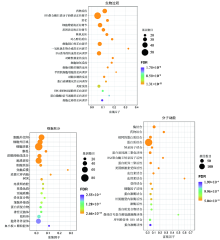
Fig.5
Biological process, cell component, and molecular function of potential anti-inflammatory targets of Anemarrhenae Rhizoma-Rhellodendri Chinensis Cortex"
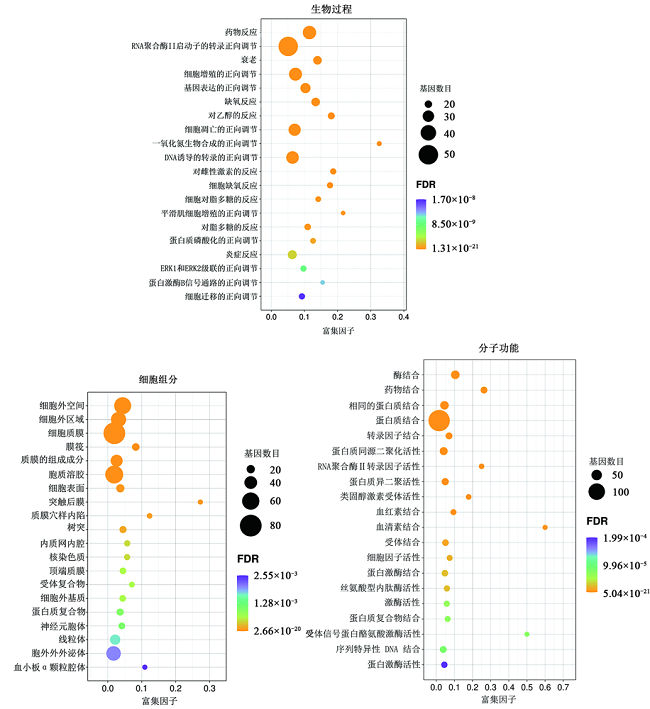
Fig.6
KEGG pathway of the potential anti-inflammatory targets of Anemarrhenae Rhizoma-Rhellodendri Chinensis Cortex"
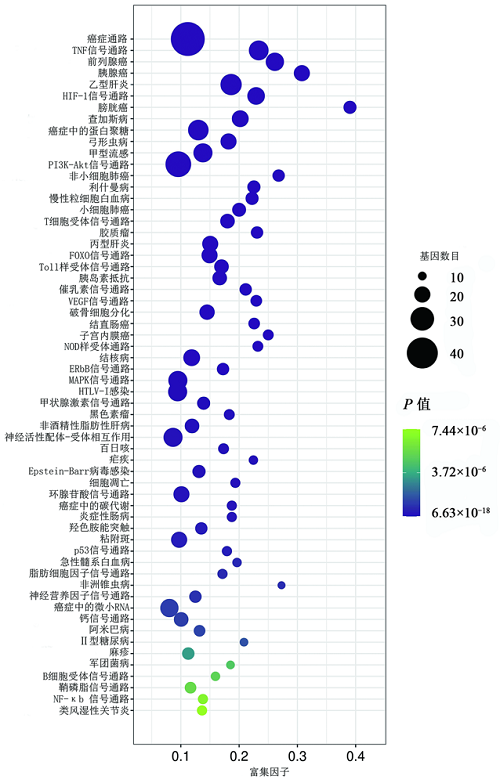
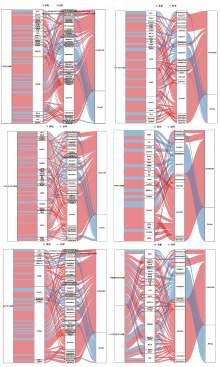
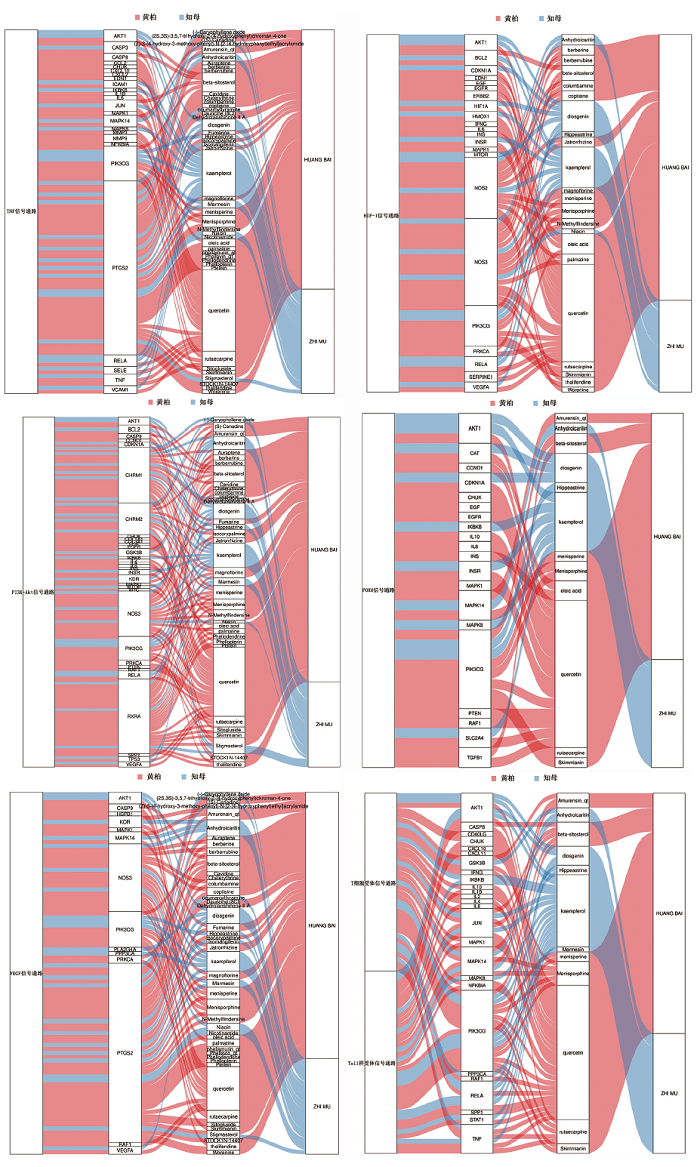
Fig.7
Sankey diagram of TCM-constituents-targets-pathways of Anemarrhenae Rhizoma-Rhellodendri Chinensis Cortex"
| [1] |
范顺明, 张春玲, 罗婷, 等. 知母-黄柏药对盐炙前后对肾阴虚大鼠滋阴清热作用的影响[J]. 中药新药与临床药理, 2020, 31(10):1141-1146. DOI: 10.19378/j.issn.1003-9783.2020.10.002.
doi: 10.19378/j.issn.1003-9783.2020.10.002 |
|
FAN S M, ZHANG C L, LUO T, et al. Study on effect of nourishing yin and clearing heat of Zhimu-Huangbo herb pair processed with salt on kidney-yin deficiency rats[J]. Traditional Chinese Drug Research and Clinical Pharmacology, 2020, 31(10):1141-1146. DOI: 10.19378/j.issn.1003-9783.2020.10.002.
doi: 10.19378/j.issn.1003-9783.2020.10.002 |
|
| [2] |
刘静, 李艳, 辛永涛, 等. 知柏药对原料提取物对小鼠糖尿病周围神经病变的药效作用[J]. 广州中医药大学学报, 2016, 33(1):103-109. DOI: 10.13359/j.cnki.gzxbtcm.2016.01.025.
doi: 10.13359/j.cnki.gzxbtcm.2016.01.025 |
|
LIU J, LI Y, XIN Y T, et al. Pharmacodynamics study of extract from raw material of rhizoma anemarrhenae and cortex phellodendri for treatment of mice with diabetic peripheral neuropathy[J]. Journal of Guangzhou University of Traditional Chinese Medicine, 2016, 33(1):103-109. DOI: 10.13359/j.cnki.gzxbtcm.2016.01.025.
doi: 10.13359/j.cnki.gzxbtcm.2016.01.025 |
|
| [3] |
金惠杰, 邱昆成, 李嘉华, 等. 药对知母-黄柏对胰岛素抵抗的改善作用[J]. 中国药理学通报, 2019, 35(7):1020-1024. DOI: 10.3969/j.issn.1001-1978.2019.07.025.
doi: 10.3969/j.issn.1001-1978.2019.07.025 |
|
JIN H J, QIU K C, LI J H, et al. The improving effect of Zhimu-Huangbai herb pair on insulin resistance[J]. Chinese Pharmacological Bulletin, 2019, 35(7):1020-1024. DOI: 10.3969/j.issn.1001-1978.2019.07.025.
doi: 10.3969/j.issn.1001-1978.2019.07.025 |
|
| [4] |
刘静, 党院霞, 高英, 等. 知母-黄柏药对有效部位群改善2型糖尿病大鼠认知功能障碍的药效及机制研究[J]. 中草药, 2017, 48(19):4037-4043. DOI: 10.7501/j.issn.0253-2670.2017.19.021.
doi: 10.7501/j.issn.0253-2670.2017.19.021 |
|
LIU J, DANG Y X, GAO Y, et al. Effects and mechanism ofAnemarrhenae Rhizoma-Phellodendri Chinensis Cortex medicine effective parts to improve cognitive impairment in type 2 diabetic rats[J]. Chinese Traditional and Herbal Drugs, 2017, 48(19):4037-4043. DOI: 10.7501/j.issn.0253-2670.2017.19.021.
doi: 10.7501/j.issn.0253-2670.2017.19.021 |
|
| [5] | 董红彦, 杜武勋, 张富庚, 等. 网络药理学及其在中医药领域的研究进展[J]. 中医药导报, 2016, 22(18):67-70. |
| DONG H Y, DU W X, ZHANG F G, et al. Network pharmacology and its research progress in the field of TCM[J]. Guiding Journal of Traditional Chinese Medicine and Pharmacology, 2016, 22(18):67-70. | |
| [6] |
操映倩, 盛军庆, 薛亚楠, 等. 基于网络药理学的知母黄柏药对防治糖尿病的作用机制研究[J]. 时珍国医国药, 2020, 31(6):1505-1509. DOI: 10.3969/j.issn.1008-0805.2020.06.078.
doi: 10.3969/j.issn.1008-0805.2020.06.078 |
|
CAO Y Q, SHENG J Q, XUE Y N, et al. Study on the Mechanism of Rhizoma Anemarrhenae on Prevention and treatment of Diabetes based on Network Pharmacology[J]. Lishizhen Medicine and Materia Medica Research, 2020, 31(6):1505-1509. DOI: 10.3969/j.issn.1008-0805.2020.06.078.
doi: 10.3969/j.issn.1008-0805.2020.06.078 |
|
| [7] |
刘顺, 邹恺平, 董辰, 等. 基于网络药理学的黄柏-知母药对药效物质基础及作用机制研究[J]. 中南药学, 2020, 18(1):147-153. DOI: 10.7539/j.issn.1672-2981.2020.01.032.
doi: 10.7539/j.issn.1672-2981.2020.01.032 |
|
LIU S, ZOU K P, DONG C, et al. Material basis and mechanism of Phellodendri Chinensis Cortex-Anemarrhenae Rhizoma based on network pharmacology[J]. Central South Pharmacy, 2020, 18(1):147-153. DOI: 10.7539/j.issn.1672-2981.2020.01.032.
doi: 10.7539/j.issn.1672-2981.2020.01.032 |
|
| [8] |
温东晟, 朱思濛, 邱煜程, 等. 炎症反应的负性调控机制[J]. 生命的化学, 2019, 39(6):1194-1198. DOI: 10.13488/j.smhx.20180099.
doi: 10.13488/j.smhx.20180099 |
|
WEN D S, ZHU S M, QIU Y C, et al. The mechanism of negative regulation in inflammation[J]. Chemistry of Life, 2019, 39(6):1194-1198. DOI: 10.13488/j.smhx.20180099.
doi: 10.13488/j.smhx.20180099 |
|
| [9] |
王瑞成, 谢培, 雷莉妍, 等. 知母-黄柏药对抗炎药效部位筛选及作用机制研究[J]. 中药材, 2019, 42(2):409-413. DOI: 10.13863/j.issn1001-4454.2019.02.037.
doi: 10.13863/j.issn1001-4454.2019.02.037 |
|
WANG R C, XIE P, LEI L Y, et al. Study on effective fraction screen and mechanism of anemarrhenae rhizoma-phellodendri chinensis cortex herb pair on anti-inflammation[J]. Journal of Chinese Medicinal Materials, 2019, 42(2):409-413. DOI: 10.13863/j.issn1001-4454.2019.02.037.
doi: 10.13863/j.issn1001-4454.2019.02.037 |
|
| [10] |
RU J L, LI P, WANG J N, et al. TCMSP: a database of systems pharmacology for drug discovery from herbal medicines[J]. Journal of Cheminformatics, 2014, 6:13. DOI: 10.1186/1758-2946-6-13.
doi: 10.1186/1758-2946-6-13 |
| [11] |
XU H Y, ZHANG Y Q, LIU Z M, et al. ETCM: anencyclopaedia of traditional Chinese medicine[J]. Nucleic Acids Research, 2019, 47(D1):D976-D982. DOI: 10.1093/nar/gky987.
doi: 10.1093/nar/gky987 |
| [12] |
AMBERGER J S, HAMOSH A. Searching online Mendelian inheritance in man (OMIM): A knowledgebase of human genes and genetic phenotypes[J]. Current Protocols in Bioinformatics, 2017, 58:1.2.1-1.2.1.2.12. DOI: 10.1002/cpbi.27.
doi: 10.1002/cpbi.27 |
| [13] |
YU W, CLYNE M, KHOURY M J, et al. Phenopedia and Genopedia: Disease-centered and gene-centered views of the evolving knowledge of human genetic associations[J]. Bioinformatics, 2010, 26(1):145-146. DOI: 10.1093/bioinformatics/btp618.
doi: 10.1093/bioinformatics/btp618 |
| [14] | OLIVEROS J.C. An interactive tool for comparing lists with Venn's diagrams[EB/OL]. [2020-01-05]https://bioinfogp.cnb.csic.es/tools/venny/index.html. |
| [15] |
赵静, 田赛赛, 杨健, 等. 清肺排毒汤治疗新型冠状病毒肺炎机制的网络药理学探讨[J]. 中草药, 2020, 51(4):829-835. DOI: 10.7501/j.issn.0253-2670.2020.04.001.
doi: 10.7501/j.issn.0253-2670.2020.04.001 |
|
ZHAO J, TIAN S S, YANG J, et al. Investigating mechanism of Qing-Fei-Pai-Du-Tang for treatment of COVID-19 by network pharmacology[J]. Chinese Traditional and Herbal Drugs, 2020, 51(4):829-835.DOI: 10.7501/j.issn.0253-2670.2020.04.001.
doi: 10.7501/j.issn.0253-2670.2020.04.001 |
|
| [16] |
陶晓倩, 张新庄, 李娜, 等. 网络药理学方法研究赤芍和黄柏干预阿尔茨海默病的作用机制[J]. 中草药, 2015, 46(11):1634-1639. DOI: 10.7501/j.issn.0253-2670.2015.11.013.
doi: 10.7501/j.issn.0253-2670.2015.11.013 |
|
TAO X Q, ZHANG X Z, LI N, et al. Study on molecular mechanism of Paeoniae Rubra Radix and Phellodendri Cortex intervening Alzheimer's disease using network pharmacology methods[J]. Chinese Traditional and Herbal Drugs, 2015, 46(11):1634-1639. DOI: 10.7501/j.issn.0253-2670.2015.11.013.
doi: 10.7501/j.issn.0253-2670.2015.11.013 |
|
| [17] |
LI S, ZHANG Z Q, WU L J, et al. Understanding ZHENG in traditional Chinese medicine in the context of neuro-endocrine-immune network[J]. IET Systems Biology, 2007, 1(1):51-60. DOI: 10.1049/iet-syb:20060032.
doi: 10.1049/iet-syb:20060032 |
| [18] |
HUANG D W, SHERMAN B T, LEMPICKI R A. Systematic and integrative analysis of large gene lists using DAVID bioinformatics resources[J]. Nature Protocols, 2009, 4(1):44-57. DOI: 10.1038/nprot.2008.211.
doi: 10.1038/nprot.2008.211 |
| [19] |
张亚楠, 王帅, 包永睿, 等. 知母不同药用部位体外抗肿瘤、抗炎及抗氧化的作用研究[J]. 世界科学技术-中医药现代化, 2019, 21(3):424-430. DOI: 10.11842/wst.2019.03.015.
doi: 10.11842/wst.2019.03.015 |
|
ZHANG Y N, WANG S, BAO Y R, et al. Research of different medicinal parts of Anemarrhena asphodeloides on anti-tumor, anti-inflammatory and anti-oxidation in vitro based on pharmacodynamics[J]. World Science and Technology-Modernization of Traditional Chinese Medicine, 2019, 21(3):424-430. DOI: 10.11842/wst.2019.03.015.
doi: 10.11842/wst.2019.03.015 |
|
| [20] | 郭鹤云. 黄柏苷及绿原酸诱导A549细胞凋亡机制的研究[D]. 长春:吉林大学, 2017. |
| GUO H Y. Studies on the mechanism of apoptosis in A549 cells induced by phellamurin and chlorogenic[D]. Changchun:Jilin University, 2017. |
|
||

Open Access This article is licensed under a Creative Commons Attribution-NonCommercial 4.0 International License (CC BY-NC 4.0), which permits third parties to freely share (i.e., copy and redistribute the material in any medium or format) and adapt (i.e., remix, transform, or build upon the material) the articles published in this journal, provided that appropriate credit is given, a link to the license is provided, and any changes made are indicated. The material may not be used for commercial purposes. For details of the CC BY-NC 4.0 license, please visit: https://creativecommons.org/licenses/by-nc/4.0
