

Shandong Science ›› 2021, Vol. 34 ›› Issue (6): 1-8.doi: 10.3976/j.issn.1002-4026.2021.06.001
• Traditional Chinese Medicine and Natural Active Products • Next Articles
Ming MEI1( ),Jin ZHOU1,Yi ZHANG1,Liang-peng MA1,Ming YANG2,Song HU1,*()
Received:2021-04-30
Published:2021-12-20
Online:2021-12-08
Contact:
Song HU
E-mail:799614276@qq.com;enterypa@126.com
CLC Number:
Ming MEI,Jin ZHOU,Yi ZHANG,Liang-peng MA,Ming YANG,Song HU. Isolation and purification of polysaccharide from Smilacis Chinae Rhizoma[J].Shandong Science, 2021, 34(6): 1-8.
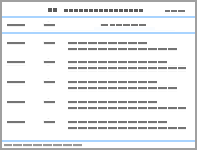
Table 1
Investigation of standing temperature"
| 温度/℃ | 多糖纯度/% | 多糖出膏率/% |
|---|---|---|
| 25 8 2 | 51.18 52.23 51.72 | 2.17 2.16 2.14 |
Table 2
Investigation of standing time"
| 时间/h | 多糖纯度/% | 多糖出膏率/% |
|---|---|---|
| 6 12 24 | 46.21 51.54 52.12 | 1.42 2.12 2.14 |
| 48 | 52.14 | 2.15 |
Table 3
Study of liquid concentration"
| 提取液生药质量浓度/(g·mL-1) | 多糖纯度/% | 多糖出膏率/% |
|---|---|---|
| 0.5 0.8 1.0 | 43.95 46.81 51.89 | 1.97 2.09 2.15 |
| 1.2 | 51.81 | 2.07 |
Table 4
Investigation of ethanol concentration"
| 乙醇体积分数/% | 多糖纯度/% | 多糖出膏率/% |
|---|---|---|
| 60 70 80 | 32.92 49.12 51.23 | 1.87 1.98 2.15 |
| 90 | 51.25 | 2.13 |
Table 5
Investigation on times of alcohol precipitation"
| 醇沉次数 | 多糖纯度/% | 多糖出膏率/% |
|---|---|---|
| 1 2 3 | 51.13 52.01 52.12 | 2.13 2.09 2.04 |
Table 6
Results of proving experiment"
| 项目 | 多糖纯度/% | 多糖出膏率/% | ||
|---|---|---|---|---|
| 编号 | 1 2 3 | 51.51 52.47 51.32 | 2.13 2.11 2.12 | |
| 均值 | 51.77 | 2.12 | ||
Table 7
Results of static adsorption rate and resolution rate of macroporous resin"
| 型号 | 吸附率/% | 解吸率/% |
|---|---|---|
| AB-8 HPD100 D101 | 78.2 69.9 75.9 | 83.9 64.5 52.5 |
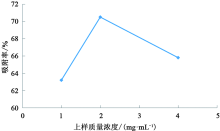
Fig.1
Investigation result of sample concentration"
Table 8
Investigation result of loading quantity"
| 上样量/BV | 吸附率/% |
|---|---|
| 1 | 69.2 |
| 2 | 65.5 |
| 3 | 59.2 |
| 4 | 55.3 |
| 5 | 49.8 |
Table 9
Investigation result of elution solvent"
| 洗脱溶剂 | 吸光度 |
|---|---|
| 纯水 | 0.676 |
| 10%乙醇 | 0.663 |
| 15%乙醇 | 0.427 |
| 30%乙醇 | 0.332 |
| 40%乙醇 | 0.142 |
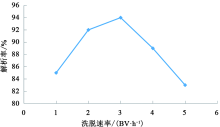
Fig.2
Investigation result of elution rate"
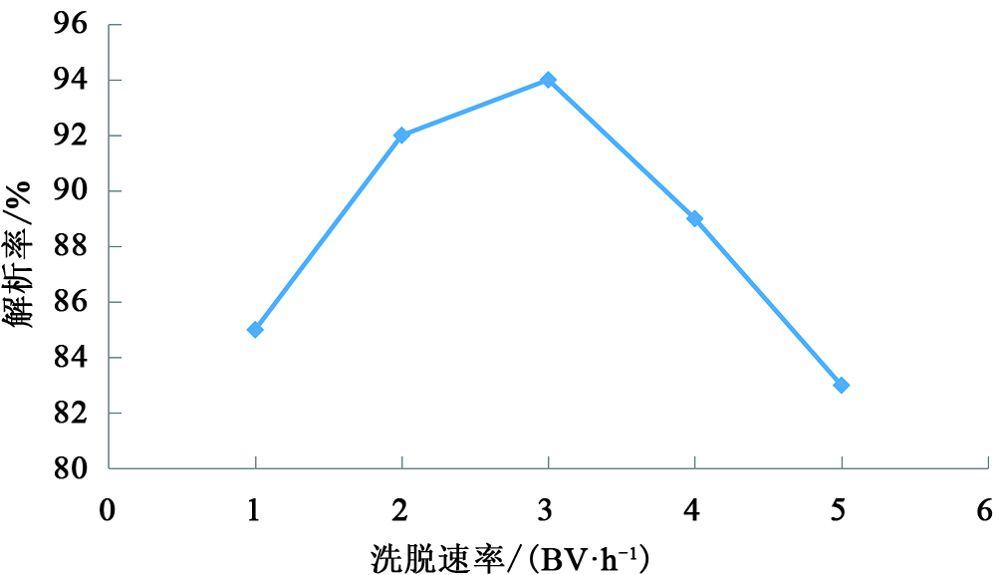
Fig.3
Investigation result of elution amount"
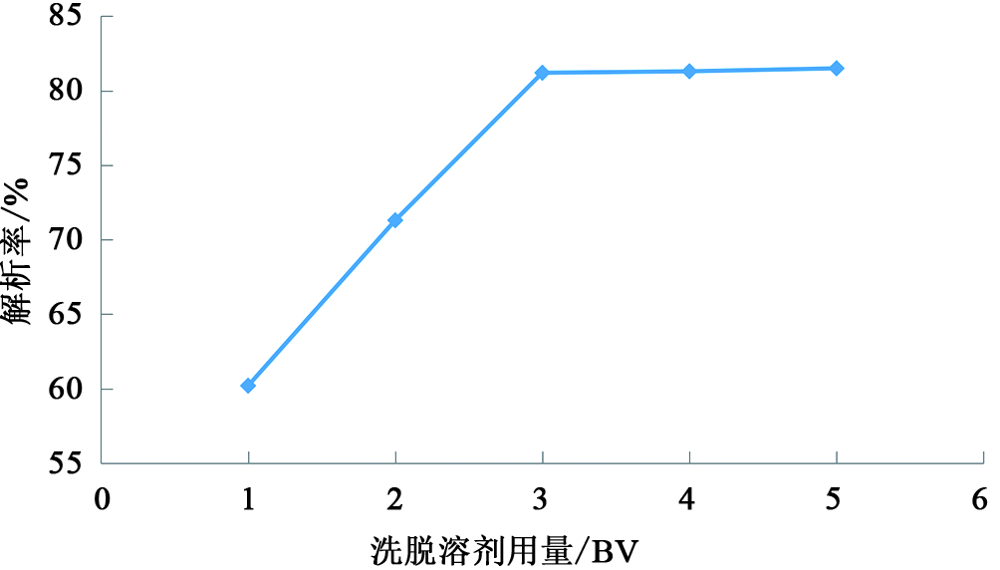
Table 10
Results of proving experiment"
| 项目 | 多糖纯度/% | 多糖得率/% | |
|---|---|---|---|
| 编号 | 1 | 60.43 | 1.01 |
| 2 | 60.51 | 1.03 | |
| 3 | 60.49 | 1.06 | |
| 均值 | 60.48 | 1.03 | |
| [1] | 全国中草药汇编编写组. 全国中草药汇编(上册)[M]. 北京: 人民卫生出版社, 1976: 752. |
| National compilation group of Chinese herbal medicine. National compilation of Chinese herbal medicine (Volume 1)[M]. Beijing: People's Health Publishing House, 1976: 752. | |
| [2] | 吕翼, 吕金清, 裴学军. 药用金刚藤名实考证[J]. 河北中医杂志, 2002, 24(5):47-48. |
| LÜ Y, LÜ J Q, PEI X J. Textual research on the name of Smilacis chinae rhizoma[J]. Hebei Journal of Traditional Chinese Medicine, 2002, 24(5):47-48. | |
| [3] | 国家药典委员会. 中华人民共和国药典2015年版一部[S]. 北京: 中国医药科技出版社, 2015: 308. |
| Chinese Pharmacopoeia Commission. Pharmacopoeia of the People's Republic of China 2015 Volume 1[M]. Beijing: China Medical Science and Technology Press, 2015: 308. | |
| [4] |
齐进, 崔颖娜. 金刚藤多糖对慢性盆腔炎大鼠炎症介质、细胞凋亡及免疫细胞功能的影响[J]. 海南医学院学报, 2018, 24(13):1219-1221. DOI: 10.13210/j.cnki.jhmu.20180515.002.
doi: 10.13210/j.cnki.jhmu.20180515.002 |
|
QI J, CUI Y N. Effects of smilax bockii warb polysaccharide on inflammatory mediators,apoptosis and immune cell function in rats with chronic pelvic inflammatory disease[J]. Journal of Hainan Medical University, 2018, 24(13):1219-1221. DOI: 10.13210/j.cnki.jhmu.20180515.002.
doi: 10.13210/j.cnki.jhmu.20180515.002 |
|
| [5] |
吴大章, 苏泰安, 代华均, 等. 金刚藤多糖对大鼠慢性盆腔炎的治疗作用及对血清免疫球蛋白的影响[J]. 中药药理与临床, 2015, 31(4):127-129. DOI: 10.13412/j.cnki.zyyl.2015.04.039.
doi: 10.13412/j.cnki.zyyl.2015.04.039 |
|
WU D Z, SU T A, DAI H J, et al. Therapeutic effect of Smilacis chinae rhizoma polysaccharide on chronic pelvic inflammatory disease in rats and its effect on serum immunoglobulin[J]. Pharmacology and Clinics of Chinese Materia Medica, 2015, 31(4):127-129. DOI: 10.13412/j.cnki.zyyl.2015.04.039.
doi: 10.13412/j.cnki.zyyl.2015.04.039 |
|
| [6] | 陈东生, 吕永宁, 王杰. 菝葜的抗炎作用[J]. 中国医院药学杂志, 2000, 20(9):544-545. |
| CHEN D S, LÜ Y N, WANG J. Study on the anti-inflaminatory effect of Smilax china L.[J]. Chinese Journal of Hospital Pharmacy, 2000, 20(9):544-545. | |
| [7] | 王立红, 何轩辉, 马涛, 等. 中药复方GCRF水提醇沉工艺的优化及对瘀热心梗大鼠心功能的改善[J]. 中国新药杂志, 2019, 28(7):862-870. |
| WANG L H, HE X H, MA T, et al. Optimization of water extraction and alcohol precipitation process and improvement of cardiac function in rats with myocardial infarction (stasis-heat syndrome) for GCRF formula[J]. Chinese Journal of New Drugs, 2019, 28(7):862-870. | |
| [8] | 丛婧, 王秀丽. 响应曲面法优选人参葛根煎膏醇沉工艺[J]. 中国药业, 2019, 28(16):17-19. |
| CONG J, WANG X L. Optimization of ethanol precipitation process of Panax Ginseng and Pueraria Lobata concentrated decoction by response surface method[J]. China Pharmaceuticals, 2019, 28(16):17-19. | |
| [9] |
董建新, 俞涵, 姜伟, 等. 响应面法优化白及多糖的提取和醇沉工艺[J]. 基因组学与应用生物学, 2019, 38(8):3681-3689. DOI: 10.13417/j.gab.038.003681.
doi: 10.13417/j.gab.038.003681 |
|
DONG J X, YU H, JIANG W, et al. Optimization of extraction and alcohol precipitation process of Bletilla striata polysaccharides based on response surface methodology[J]. Genomics and Applied Biology, 2019, 38(8):3681-3689. DOI: 10.13417/j.gab.038.003681.
doi: 10.13417/j.gab.038.003681 |
|
| [10] | 罗开沛, 李小芳, 林浩, 等. 山香圆叶提取液纯化工艺的优化[J]. 中成药, 2017, 39(4):727-731. |
| LUO K P, LI X F, LIN H, et al. Optimization of purification of extract from Turpinia arguta leaves[J]. Chinese Traditional Patent Medicine, 2017, 39(4):727-731. | |
| [11] |
冯素香, 苗明三, 苗晋鑫, 等. AB-8大孔吸附树脂同时分离纯化毛冬青总黄酮、总皂苷工艺[J]. 中国实验方剂学杂志, 2012, 18(3):5-8. DOI: 10.13422/j.cnki.syfjx.2012.03.037.
doi: 10.13422/j.cnki.syfjx.2012.03.037 |
|
FENG S X, MIAO M S, MIAO J X, et al. Simultaneous separation and purification technology of total flavonoids and total saponins from Llex pubescens by AB-8 macroporous resin[J]. Chinese Journal of Experimental Traditional Medical Formulae, 2012, 18(3):5-8. DOI: 10.13422/j.cnki.syfjx.2012.03.037.
doi: 10.13422/j.cnki.syfjx.2012.03.037 |
|
| [12] | 杨丽, 王宏伟, 李洪波, 等. 大孔树脂法富集黄芩籽种壳总黄酮[J]. 医药导报, 2017, 36(4):420-424. |
| YANG L, WANG H W, LI H B, et al. Enrichment of total flavonoids from seed shell of Scutellaria Baicalensis by macroporous resin[J]. Herald of Medicine, 2017, 36(4):420-424. | |
| [13] |
梅明, 杨全伟, 马良鹏, 等. 红梅消总皂苷分离纯化及体外抗凝血活性研究[J]. 现代中药研究与实践, 2018, 32(4):36-39. DOI: 10.13728/j.1673-6427.2018.04.010.
doi: 10.13728/j.1673-6427.2018.04.010 |
|
MEI M, YANG Q W, MA L P, et al. Isolation and purification of Rubus parvifolius L.and its anti-coagulant activity in vitro[J]. Research and Practice on Chinese Medicines, 2018, 32(4):36-39. DOI: 10.13728/j.1673-6427.2018.04.010.
doi: 10.13728/j.1673-6427.2018.04.010 |
|
| [14] |
王维. 桑叶多糖提取与纯化工艺的研究[D]. 西安:陕西科技大学, 2006. DOI: 10.7666/d.y973741.
doi: 10.7666/d.y973741 |
|
WANG W. Study on the extraction and purifiying technology of polysaccharide in morus alba leaves[D]. Xi'an: Shaanxi University of Science & Technology, 2006. DOI: 10.7666/d.y973741.
doi: 10.7666/d.y973741 |
|
| [15] |
刘富岗, 李汉伟, 郑群杰, 等. 响应面法优选泽兰多糖的大孔吸附树脂纯化工艺[J]. 暨南大学学报(自然科学与医学版), 2019, 40(1):1-9. DOI: 10.11778/j.jdxb.2019.01.001.
doi: 10.11778/j.jdxb.2019.01.001 |
|
LIU F G, LI H W, Z Q J, et al. Optimization of purification process of Lycopus lucidus polysaccharide with macroporous adsorption resins by response surface method[J]. Journal of Jinan University(Natural Science & Medicine Edition), 2019, 40(1):1-9. DOI: 10.11778/j.jdxb.2019.01.001.
doi: 10.11778/j.jdxb.2019.01.001 |
|
| [16] |
赵芷萌, 赵宏, 王宇亮, 等. 百合多糖的纯化及其对肠道菌群失调小鼠的调节作用[J]. 食品工业科技, 2020, 41(8):295-300. DOI: 10.13386/j.issn1002-0306.2020.08.047.
doi: 10.13386/j.issn1002-0306.2020.08.047 |
|
ZHAO Z M, ZHAO H, WANG Y L, et al. Purification of lily polysaccharide and its regulatory effect on intestinal flora dysregulation mice[J]. Science and Technology of Food Industry, 2020, 41(8):295-300. DOI: 10.13386/j.issn1002-0306.2020.08.047.
doi: 10.13386/j.issn1002-0306.2020.08.047 |
|
| [17] |
刘富岗, 冯素香, 张杰, 等. 白屈菜多糖纯化工艺的优化[J]. 中成药, 2018, 40(2):475-477. DOI: 10.3969/j.issn.1001-1528.2018.02.048.
doi: 10.3969/j.issn.1001-1528.2018.02.048 |
|
LIU F G, FENG S X, ZHANG J, et al. Optimization of purification process of Polysaccharides from Chelidonium majus[J]. Chinese Traditional Patent Medicine, 2018, 40(2):475-477. DOI: 10.3969/j.issn.1001-1528.2018.02.048.
doi: 10.3969/j.issn.1001-1528.2018.02.048 |
|
| [18] |
汤如莹, 王玉杰, 李伟, 等. D101型大孔吸附树脂分离纯化沙苑子总黄酮工艺研究[J]. 中草药, 2017, 48(16):3342-3346. DOI: 10.7501/j.issn.0253-2670.2017.16.014.
doi: 10.7501/j.issn.0253-2670.2017.16.014 |
|
TANG R Y, WANG Y J, LI W, et al. Purification of total flavonoids extracted from Astragali Complanati Semen using D-101 macroporous adsorption resin[J]. Chinese Traditional and Herbal Drugs, 2017, 48(16):3342-3346. DOI: 10.7501/j.issn.0253-2670.2017.16.014.
doi: 10.7501/j.issn.0253-2670.2017.16.014 |
|
| [19] | 国家药品监督管理局. 药品注册管理办法[EB/OL]. (2020-03-30 )[2020-08-03]. https://www.nmpa.gov.cn/directory/web/nmpa/xxgk/fgwj/bmgzh/20200330180501220.html. |
| National Medical Products Administration. Measures for the administration of drug registration[EB/OL]. (2020-03-30 )[2020-08-03]. https://www.nmpa.gov.cn/directory/web/nmpa/xxgk/fgwj/bmgzh/20200330180501220.html. |
| [1] | YANG Zhicheng, SUN Caihong, YE Guan. Quality evaluation of Ganoderma lucidum as a medicinal material based on polysaccharides and entropy-weighted TOPSIS [J]. Shandong Science, 2024, 37(6): 31-41. |
| [2] | ZENG Ting, YANG Ran, LI Qingjun, GONG Yanan, WANG Shuzhen, LIU Qian. Effects of Dioscorea opposita Thunb. polysacchariades on exercise-related fatigue in mice through the PI3K/AKT/Gsk-3β pathway [J]. Shandong Science, 2024, 37(6): 51-58. |
| [3] | MIAO Xuzhong, LI Xiufen, GAO Yanyan, ZHANG Xue, ZHANG Xiqing, QIAO Luqin. Optimization of preparation of persimmon peel polysaccharide chromium using response surface methodology [J]. Shandong Science, 2024, 37(2): 127-134. |
| [4] | BI Yan-yan, MA Qing-wen, XU Hui, LIU Jian, LONG Rui, TANG Wei-ming, GUO Tian-tian, HAO Da-wei. Optimization of the column chromatographic purification of total flavonoids extracted from Ginkgo biloba using Box-Behnken design and response surface method [J]. Shandong Science, 2022, 35(6): 8-15. |
| [5] | YI Sai-ni, ZHANG Wen-jiao, LI Liang-yuan, XIAO Cheng-hong, TANG Xin, LIU Qin, SU Da-peng, XU Chun-yun, Zhang Jin-qiang, ZHOU Tao. The inhibition of loganin on microglia activation [J]. Shandong Science, 2021, 34(5): 34-41. |
| [6] | LI Ling-yu, LI Yu-chen, ZUO Zhao-he, TIAN bao-lan, ZHENG Zhen-jia. Development of high performance gel chromatography for the determination of inulin polymerization [J]. Shandong Science, 2020, 33(4): 1-6. |
| [7] | LU Xu-qiang, LIU Dai-cheng, LIU Jun, LI Cheng-hui, LI Min, YIN Cheng-wen. Extraction and purification process of daidzein by using soy whey water as raw material [J]. Shandong Science, 2020, 33(1): 29-34. |
| [8] | LIU Fa-sheng, WANG Rong-chun, GUO Jing-lan, CHEN Yan-li, XIA Qing, KONG Hao-tian, FENG Run-liang, HAN Li-wen, ZHANG Ai-ping, LIU Ke-chun. The immune-regulatory effects of active ingredients of asparagus using zebrafish model [J]. SHANDONG SCIENCE, 2017, 30(6): 29-34. |
| [9] | WANG Tao, WANG Xiao-hui, CHEN Yan-nan, YANG Fan, ZHANG Chong, WANG Xiao. Preliminary study on the quality evaluation of Bletilla striata powder [J]. SHANDONG SCIENCE, 2017, 30(3): 26-32. |
| [10] | ZHANG Ying-jie, GENG Yan-ling, WANG Xiao, LIU Feng. Extraction and deproteinization technology for polysaccharide from Dendrobium officinale protocorm [J]. SHANDONG SCIENCE, 2016, 29(3): 7-12. |
| [11] | XIE Yingying,CUI Ning,GUO Wei,YU Zongyuan. Preparation method of polysaccharides with immune activity from Radix Glehniae [J]. SHANDONG SCIENCE, 2015, 28(6): 1-5. |
| [12] | MA Yao-Hong, MENG Qing-Jun, YANG Yan, YANG Jun-Hui, SHI Jian-Guo, ZHANG Li-Qun, ZHENG Lan, LIU Wei-Xia. A hydrolysis process based rapid identification approach for polysaccharides [J]. SHANDONG SCIENCE, 2014, 27(4): 12-16. |
| [13] | ZHANG Yue-Hui, MA Yao-Hong, Shi-Jian-Guo, YANG Dun-Hui. Research on cellulase degradation extraction of polysaccharide in rose dregs [J]. J4, 2012, 25(3): 71-74. |
| [14] | FANG Lu, QI Qiu-Yue, LI Bin, JIA Ze-Feng. Mycelial growth of fermentation medium of white Hypsizigus marmoreus and the optimization of exopolysaccharides medium [J]. J4, 2012, 25(1): 24-31. |
| [15] | WANG Shao-Jie, ZHANG Ling-Lian, XU Ling-Chuan, LIU Yu-Hong, JIANG Hai-Qiang. Content determination of total polysaccharides in leaves of Pyrus betulaefolia Bge. from different processing methods [J]. J4, 2011, 24(4): 15-17. |
|
||

Open Access This article is licensed under a Creative Commons Attribution-NonCommercial 4.0 International License (CC BY-NC 4.0), which permits third parties to freely share (i.e., copy and redistribute the material in any medium or format) and adapt (i.e., remix, transform, or build upon the material) the articles published in this journal, provided that appropriate credit is given, a link to the license is provided, and any changes made are indicated. The material may not be used for commercial purposes. For details of the CC BY-NC 4.0 license, please visit: https://creativecommons.org/licenses/by-nc/4.0
