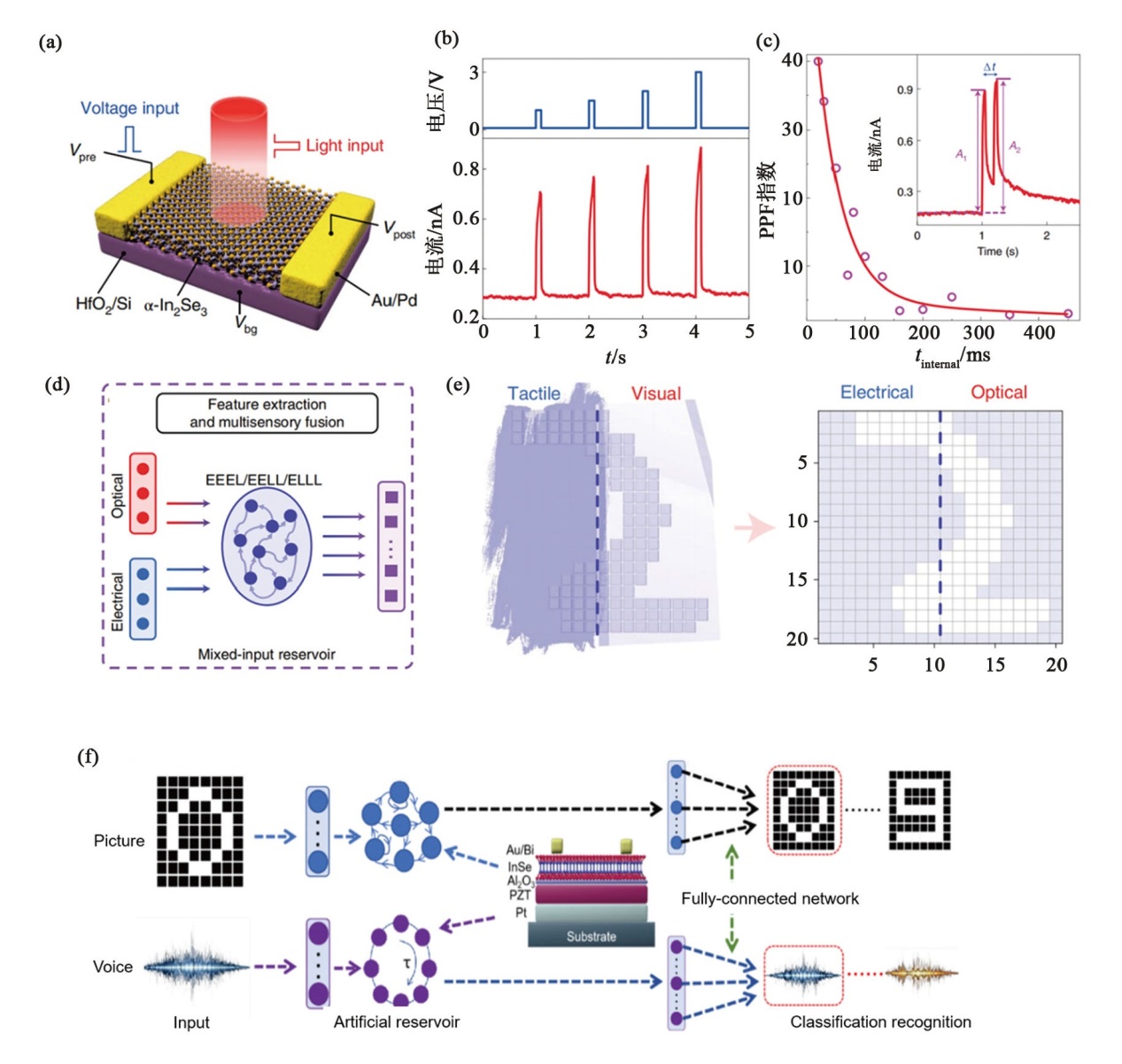
| [1] |
WANG J Y, ILYAS N, LI C M, et al. Enhanced broadband Si-based optoelectronic synapse for artificial visual applications[J]. Applied Surface Science, 2023, 614: 156232. DOI:10.1016/j.apsusc.2022.156232.
|
| [2] |
GOLNABI H, ASADPOUR A. Design and application of industrial machine vision systems[J]. Robotics and Computer-Integrated Manufacturing, 2007, 23(6): 630-637. DOI:10.1016/j.rcim.2007.02.005.
|
| [3] |
MEROLLA P A, ARTHUR J V, ALVAREZ-ICAZA R, et al. Artificial brains. A million spiking-neuron integrated circuit with a scalable communication network and interface[J]. Science, 2014, 345(6197): 668-673. DOI:10.1126/science.1254642.
pmid: 25104385
|
| [4] |
NEWSOME W T, BRITTEN K H, MOVSHON J A. Neuronal correlates of a perceptual decision[J]. Nature, 1989, 341(6237): 52-54. DOI:10.1038/341052a0.
|
| [5] |
CHEN Y B, KANG Y, HAO H, et al. All two-dimensional integration-type optoelectronic synapse mimicking visual attention mechanism for multi-target recognition[J]. Advanced Functional Materials, 2023, 33(6): 2209781. DOI:10.1002/adfm.202209781.
|
| [6] |
WANG Z R, JOSHI S, SAVEL’EV S E, et al. Memristors with diffusive dynamics as synaptic emulators for neuromorphic computing[J]. Nature Materials, 2017, 16(1): 101-108. DOI:10.1038/nmat4756.
pmid: 27669052
|
| [7] |
TAKEUCHI T, DUSZKIEWICZ A J, MORRIS R G M. The synaptic plasticity and memory hypothesis: Encoding, storage and persistence[J]. Philosophical Transactions of the Royal Society of London Series B, Biological Sciences, 2013, 369(1633): 20130288. DOI:10.1098/rstb.2013.0288.
|
| [8] |
LAMPRECHT R, LEDOUX J. Structural plasticity and memory[J]. Nature Reviews Neuroscience, 2004, 5(1): 45-54. DOI:10.1038/nrn1301.
pmid: 14708003
|
| [9] |
ZENG M Y, HE Y L, ZHANG C X, et al. Neuromorphic devices for bionic sensing and perception[J]. Frontiers in Neuroscience, 2021, 15: 690950. DOI:10.3389/fnins.2021.690950.
|
| [10] |
ZHANG J Y, DAI S L, ZHAO Y W, et al. Recent progress in photonic synapses for neuromorphic systems[J]. Advanced Intelligent Systems, 2020, 2(3): 1900136. DOI:10.1002/aisy.201900136.
|
| [11] |
YANG R Q, WANG Y, LI S Q, et al. All-optically controlled artificial synapse based on full oxides for low-power visible neural network computing[J]. Advanced Functional Materials, 2024, 34(10): 2312444. DOI:10.1002/adfm.202312444.
|
| [12] |
GAO S, LIU G, YANG H L, et al. An oxide Schottky junction artificial optoelectronic synapse[J]. ACS Nano, 2019, 13(2): 2634-2642. DOI:10.1021/acsnano.9b00340.
pmid: 30730696
|
| [13] |
CHANG T, JO S H, LU W. Short-term memory to long-term memory transition in a nanoscale memristor[J]. ACS Nano, 2011, 5(9): 7669-7676. DOI:10.1021/nn202983n.
pmid: 21861506
|
| [14] |
INDIVERI G, DOUGLAS R. Neuromorphic vision sensors[J]. Science, 2000, 288(5469): 1189-1190. DOI:10.1126/science.288.5469.1189.
|
| [15] |
WANG Y, YIN L, HUANG W, et al. Optoelectronic synaptic devices for neuromorphic computing[J]. Advanced Intelligent Systems, 2021, 3(1): 2000099. DOI:10.1002/aisy.202000099.
|
| [16] |
ZHANG Y Y, CHEN L, LIU H, et al. High-performance ferroelectric based materialsvia high-entropy strategy: Design, properties, and mechanism[J]. InfoMat, 2023, 5(12): e12488. DOI:10.1002/inf2.12488.
|
| [17] |
ALI T, POLAKOWSKI P, RIEDEL S, et al. High endurance ferroelectric hafnium oxide-based FeFET memory without retention penalty[J]. IEEE Transactions on Electron Devices, 2018, 65(9): 3769-3774. DOI:10.1109/TED.2018.2856818.
|
| [18] |
HU Y Q, ZHU Y X, CHEN X L, et al. Ferroelectric-based optoelectronic synapses for visual perception: From materials to systems[J]. Nanomaterials, 2025, 15(11): 863. DOI:10.3390/nano15110863.
|
| [19] |
LI Y, SHEN G Z. Advances in optoelectronic artificial synapses[J]. Cell Reports Physical Science, 2022, 3(9): 101037. DOI:10.1016/j.xcrp.2022.101037.
|
| [20] |
LIU J, ZHANG M Y, HAN W S, et al. Ferroelectric-gated hybrid-layered organic field-effect transistors for multimode signal processing[J]. Advanced Functional Materials, 2025: e08765. DOI:10.1002/adfm.202508765.
|
| [21] |
ZHANG B Y, LI Z H, ZHANG W D, et al. Multi-functional ferroelectric domain wall nanodevices for in-memory computing and light sensing[J]. Advanced Functional Materials, 2024, 34(40): 2405587. DOI:10.1002/adfm.202405587.
|
| [22] |
HAN X, XU Z S, WU W Q, et al. Recent progress in optoelectronic synapses for artificial visual-perception system[J]. Small Structures, 2020, 1(3): 2000029. DOI:10.1002/sstr.202000029.
|
| [23] |
CUI B Y, FAN Z, LI W J, et al. Ferroelectric photosensor network: An advanced hardware solution to real-time machine vision[J]. Nature Communications, 2022, 13(1): 1707. DOI:10.1038/s41467-022-29364-8.
pmid: 35361828
|
| [24] |
WU G J, ZHANG X M, FENG G D, et al. Ferroelectric-defined reconfigurable homojunctions for in-memory sensing and computing[J]. Nature Materials, 2023, 22(12): 1499-1506. DOI:10.1038/s41563-023-01676-0.
pmid: 37770677
|
| [25] |
CI W J, XUE W H, WANG P, et al. All-In-one optoelectronic neuristor based on full-vdW two-terminal ferroelectric p-n heterojunction[J]. Advanced Functional Materials, 2024, 34(15): 2305822. DOI:10.1002/adfm.202305822.
|
| [26] |
WANG H, TANG Y S, WANG Z S, et al. Efficient and stable topological/ferroelectric Bi2Te3/SnSe hetero-memristor for in situ bionic-visual semi-hardware systems[J]. Advanced Materials, 2025, 37(35): 2501066. DOI:10.1002/adma.202501066.
|
| [27] |
ZENG J H, FENG G D, WU G J, et al. Multisensory ferroelectric semiconductor synapse for neuromorphic computing[J]. Advanced Functional Materials, 2024, 34(19): 2313010. DOI:10.1002/adfm.202313010.
|
| [28] |
LAO J, YAN M G, TIAN B B, et al. Ultralow-power machine vision with self-powered sensor reservoir[J]. Advanced Science, 2022, 9(15): 2106092. DOI:10.1002/advs.202106092.
|
| [29] |
LIU K Q, ZHANG T, DANG B J, et al. An optoelectronic synapse based on α-In2Se3 with controllable temporal dynamics for multimode and multiscale reservoir computing[J]. Nature Electronics, 2022, 5: 761-773. DOI:10.1038/s41928-022-00847-2.
|
| [30] |
CHEN J, ZHU J Q, LI P, et al. InSe dynamic memristor-based reservoir computing for temporal and spatial signal recognition[J]. Nano Letters, 2025, 25(37): 13909-13917. DOI:10.1021/acs.nanolett.5c03781.
pmid: 40905648
|
 ), ZHENG Limei*(